
KDP margin & gutter requirements, by page count
The outside margin is fixed. The inside gutter isn't — it scales with your book's final page count, and it's the single most common way formatting fails silently after a late edit.
Upload your manuscript (free preview)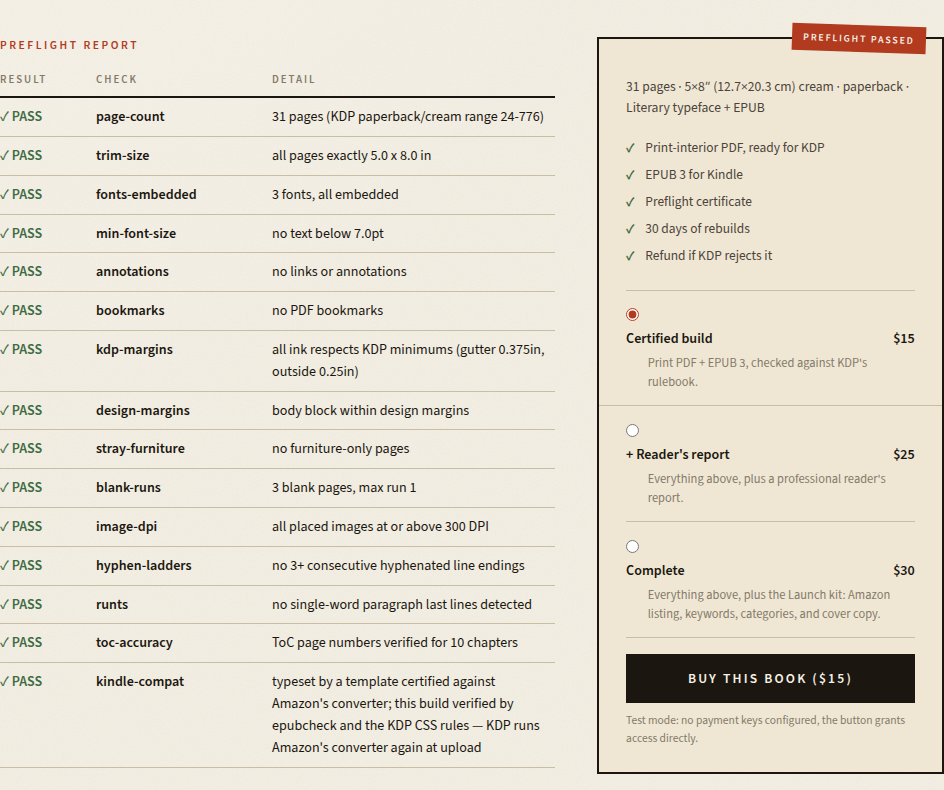
The fixed part: top, bottom, and outside edge
KDP requires at least 0.25in of clearance on the top, bottom, and outside edge of every page, regardless of page count or trim size. If anything on the page bleeds off the edge, most often a full-page image or a colored background, the minimum rises to 0.375in on the sides that bleed. This part doesn't move with your book's length; it's the same rule for a 30-page chapbook and an 800-page novel.
The part that moves: inside gutter margin
The inside gutter is the extra margin next to the spine, and it has to grow with your page count because a thicker book has a thicker spine, which physically eats further into the inside edge of every page.
Paperback
| Final page count | Minimum inside gutter |
|---|---|
| Up to 150 | 0.375in |
| 151–300 | 0.5in |
| 301–500 | 0.625in |
| 501–700 | 0.75in |
| 701–828 | 0.875in |
Hardcover
| Final page count | Minimum inside gutter |
|---|---|
| Up to 150 | 0.375in |
| 151–300 | 0.5in |
| 301–500 | 0.625in |
| 501–550 | 0.75in |
Hardcover's table stops at 550 pages because that's KDP's maximum page count for hardcover; paperback continues to 828.
The gutter is where formatting quietly breaks
A manuscript almost always gets formatted for its draft page count, early in the process. Then it changes: a chapter gets added, a scene gets expanded, front matter grows. If that growth pushes the book across one of the thresholds above, say from 295 pages to 310, the gutter needs to widen from 0.5in to 0.625in. The file will still open fine. It will still look correct on a screen. The problem only becomes visible in a printed proof, when the binding eats further into the inside margin than the layout accounted for, and text near the spine gets harder to read or, in the worst case, gets partially swallowed by the binding.
Nobody re-checks the gutter against the new page count unless something forces the recheck, because doing it by hand means re-measuring every spread after every edit. This is true whether the formatting was done by hand, by software, or by a freelancer: the rule is public, but re-verifying it after every change is the part that gets skipped.
Typesheep re-runs the gutter check, along with every other rule, on the actual final page count of your build, every time you build or rebuild. There's nothing to remember to re-check.
Common questions about KDP margins and gutter
What is the minimum outside margin for a KDP book?
0.25in on the top, bottom, and outside edge with no bleed. If any element bleeds off the page edge, the minimum rises to 0.375in on the bleed sides.
What is the inside gutter margin for a KDP paperback?
It scales with final page count: 0.375in up to 150 pages, 0.5in for 151-300, 0.625in for 301-500, 0.75in for 501-700, and 0.875in for 701-828. A thicker spine eats further into the inside margin, so the gutter grows to compensate.
Is the hardcover gutter table different from paperback?
The first three bands match (0.375in to 150 pages, 0.5in to 300, 0.625in to 500), but hardcover tops out at 0.75in for 501-550 pages, since hardcover's page limit is 550, below paperback's 828.
Why is the gutter margin the most common silent formatting failure?
A manuscript is usually formatted for its draft page count. A late edit adds a chapter, the book crosses a gutter threshold, and the file still looks correct on screen. The problem only shows up printed, once the binding eats into text near the spine. Nobody re-checks the margin against the new page count unless something forces the recheck.